Plasterers in Patchway Bristol
B&D Plastering Bristol, Quality You Can See
The most frequent call we receive from Patchway homeowners is not about a single crack or a ceiling that needs freshening up. It is about plaster that has been failing progressively across multiple walls, that sounds hollow when tapped, or that has begun to pull away from the wall in sections. This is a natural consequence of the age of the housing stock, and it calls for proper assessment and, in most cases, full replastering rather than repeated patching.
This page covers our plastering services for Patchway homeowners. For damp proofing or condensation treatment, we have separate pages for those services. Call Dave on 07754 246 461 for a free, no-obligation quote. We are available Monday to Saturday, 7am to 8pm.

Contact Dave, B&D Plastering in Patchway
Phone: 07754 246 461
Email: bdplaster@hotmail.com
Available: Monday to Saturday, 7am to 8pm
Free, no-obligation quotes | No job too big or small – residential & commercial
Experienced & Reliable
Years of experience across both domestic and commercial sectors.
Fully Insured
We carry full Public Liability Insurance for peace of mind.
Top Quality Materials
We only use the best materials on every job.
Locally Trusted
A strong local reputation across Bristol, South Gloucestershire & beyond.
What Patchway Homeowners Call Us About Most
Unlike areas built predominantly in the 1980s and 1990s, where the main plastering request is a straightforward re-skim before redecoration, Patchway generates a different kind of call. The post-war housing stock produces a specific set of plastering problems that we encounter regularly on jobs across the area. As the plasterers in Patchway that local homeowners turn to, these are the jobs that make up the bulk of our work here.
Failing Original Plaster, Full Replastering
When a property was built in the 1950s or 1960s, the original plaster was mixed and applied on site rather than being a factory-produced product. After six or seven decades, that plaster shows its age in predictable ways. It absorbs moisture more readily than it once did, it loses its bond with the wall behind, and sections begin to hollow and eventually fall. By the time many Patchway homeowners call us, patching has become a losing battle across multiple rooms.
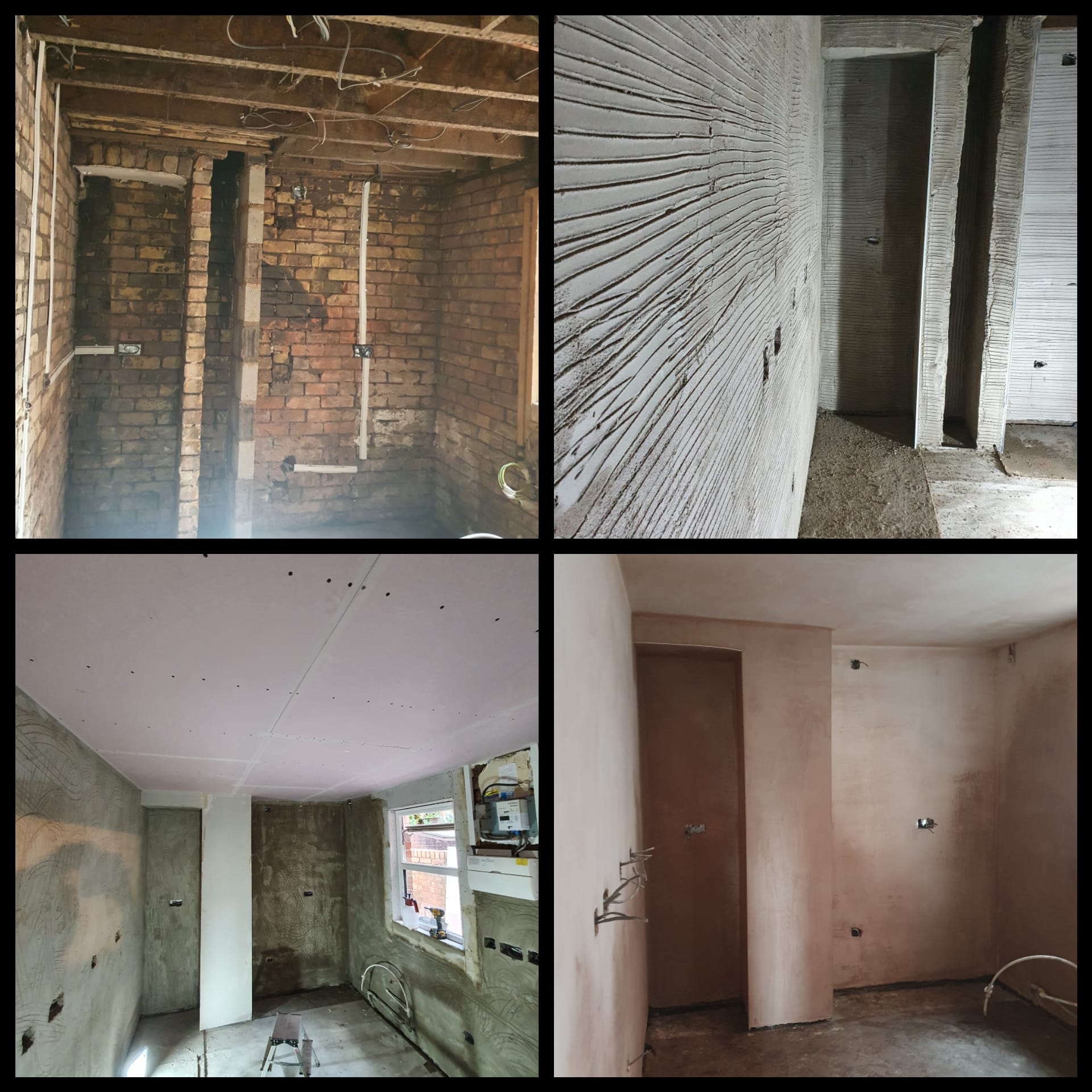
Full replastering is the correct solution in these cases, not a shortcut. We hack off all old plaster back to the bare substrate, assess the wall surface, apply the correct bonding coat or hardwall backing for the material behind, and skim to a smooth finish. Done properly, it should not need repeating within a homeowner’s lifetime. Patching over failing plaster, by contrast, gives a temporary result that costs more in the long run.
Signs that a Patchway property needs full replastering rather than a repair:
- Plaster sounds hollow across a large portion of a wall when tapped
- Cracks keep reappearing in the same locations after previous repairs
- Sections of plaster have pulled away from the wall or ceiling
- The surface crumbles easily or feels soft and powdery
- Multiple rooms showing the same pattern of deterioration
Artex Ceiling Removal, A Very Common Patchway Job
Many of Patchway’s post-war properties had cosmetic renovation work carried out in the 1970s and 1980s. One of the most common features added during that period was Artex ceiling texturing, applied over original plaster ceilings that in many cases were still perfectly sound. Decades later, removing that Artex and restoring a smooth, modern flat ceiling is among the most popular jobs that plasterers in Patchway carry out.
Several approaches are available depending on what is underneath and the depth of the texture:
- Overboarding: A fresh layer of plasterboard is fixed over the existing Artex ceiling and skimmed smooth. This is often the most practical approach, particularly where the texture is deep or the original ceiling behind it is uneven. It also avoids disturbing the Artex, which is relevant in pre-2000 properties where asbestos testing may apply.
- Skimming over: For shallower, more even textures, a plaster skim coat applied directly over the Artex builds the surface flat. Not every texture is suitable for this method, and we assess before advising.
- Full removal: Where the other options are not appropriate, the Artex is removed completely before re-skimming. Asbestos testing is strongly advised before this route in any Patchway property built or renovated before 2000.
Re-skimming Walls and Ceilings
Re-skimming is also the appropriate choice in older Patchway properties where localised areas have been properly repaired and the rest of the wall is sound. We always assess which approach is right before committing to a course of action, and we will tell you honestly if a re-skim is sufficient rather than recommend a full replaster unnecessarily.
Ceiling Repairs
Patch Repairs and Localised Work
Internal Rendering
Working as Plasterers in Patchway, What We Find on the Job
Having worked across Patchway regularly over many years, we have a practical understanding of what to expect on a job here that comes only from direct experience. Several things come up consistently:

Previous patch repairs that have not held:
Plaster over damp that was never treated:
Artex applied over original ceilings that are still sound:
A mix of property ages on the same street:
Extensions, Conversions and Improvement Work in Patchway
Beyond remedial work on ageing plaster, we carry out plastering for Patchway homeowners who are adding or improving space. Rear extensions are common across the area, as are loft conversions that bring unused space into use as housing costs have risen. Garage conversions, which involve creating habitable space from a previously unplastered structure, also generate consistent work.
For all of these, we plasterboard the new structure, apply the correct backing coat to any blockwork, and finish the extended or converted space to match the existing property. We work directly with homeowners and alongside builders, and we fit into the build programme rather than expecting the project to fit around us.
About B&D Plastering, Your Patchway Plasterer

B&D Plastering is run by Dave, a British Gypsum certified plasterer with many years of experience working across Patchway, Filton, Bristol and South Gloucestershire. We are a small, professional operation. When you book us, Dave carries out the work.
- British Gypsum certified, quality materials used and specified correctly
- Fully insured, up to £5 million public liability cover
- 5-star rated on Google and Facebook
- Free, no-obligation written quotes
- Available Monday to Saturday, 7am to 8pm
- Residential and commercial work, no job too large or small
Frequently Asked Questions Plasterers in Stoke Gifford
How do I know if my Patchway property needs a full replaster or just a re-skim?
My 1960s Patchway property has plaster coming away from the walls in several rooms. Is this normal?
We are worried about asbestos in our Artex before calling in plasterers in Patchway. What should we do?
Can you plaster a garage conversion or extension in Patchway?
How long does a full house replaster take in Patchway?
See Also
Plastering Filton | Plastering Bradley Stoke | Plastering Stoke Gifford | Damp Proofing Patchway (coming soon) | Plastering Bristol
Free plastering quote in Patchway, call 07754 246 461
Services
Specialist Damp Proofing, Condensation & Mould Prevention, All aspects of plastering and rendering including reskimming of Artex ceilings, plaster boarding, bonding, hardwall, wall plastering, ceiling plastering and more
Plastering Bristol Areas Covered
Including Bristol, South Gloucestershire, Kingswood, Bradley Stoke, Yate, Thornbury, Stoke Gifford, Patchway, Filton
Damp Proofing Bristol Areas Covered
Including Bristol, Clifton, Redland, South Gloucestershire, Kingswood, Bradley Stoke, Yate, Thornbury, Stoke Gifford, Patchway, Filton




© 2026 B&D Plastering - Website built & hosted by 29 design Ltd